Australia is moving into a significant period of offshore decommissioning. The Australian Government estimates that oil and gas titleholders will spend around $60 billion over the next 30–50 years decommissioning offshore infrastructure. Under the government's full-removal base case, about 5.7 million tonnes of material will ultimately need to be managed through reuse, recycling, disposal or storage.
Those numbers naturally focus attention on removal vessels, ports, dismantling facilities and recycling capacity. There is another question worth asking earlier in the process: does equipment that is no longer required by one operation necessarily have no remaining value?
Surplus is not always end-of-life
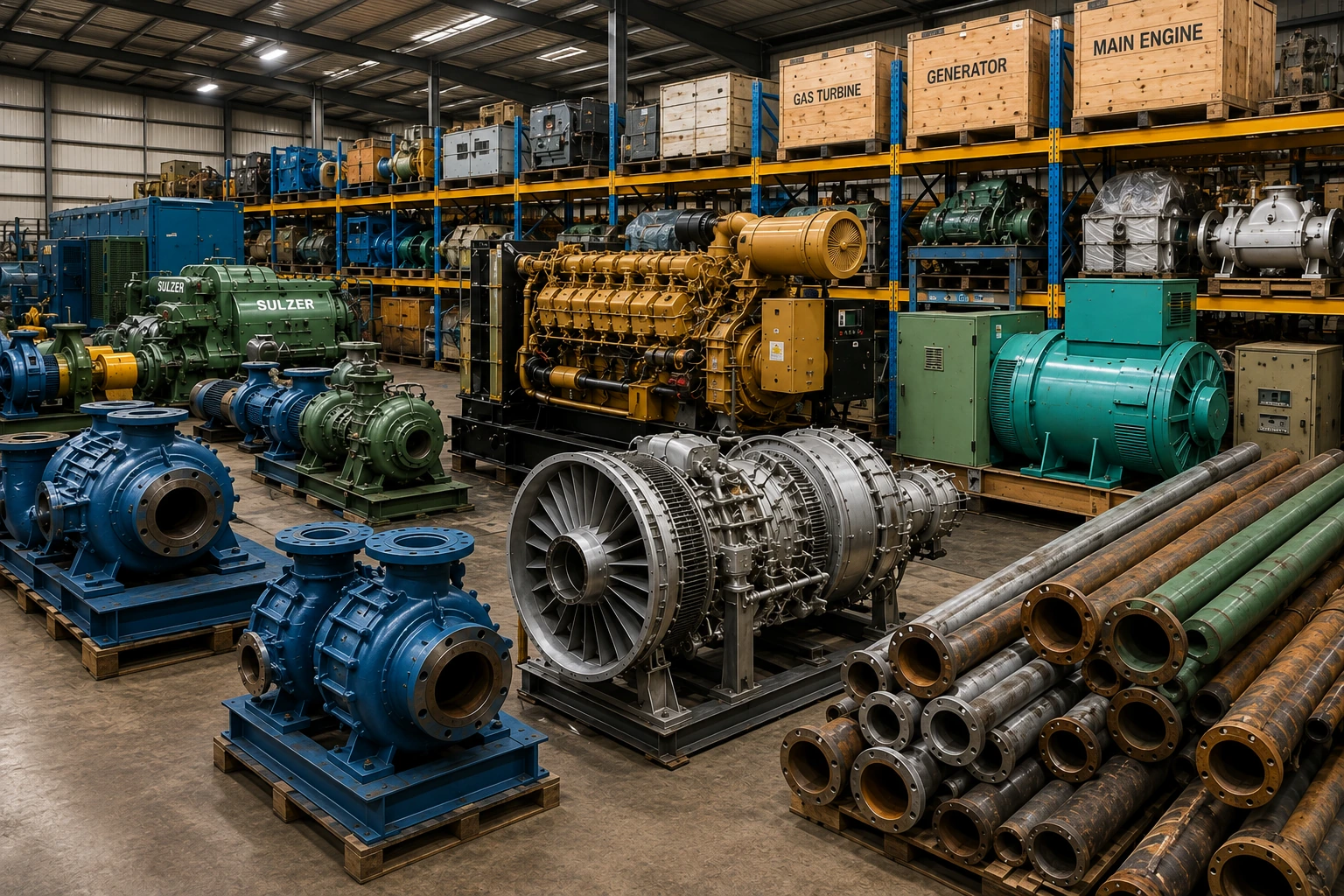
Offshore facilities, processing plants and mine sites contain large inventories of mechanical, electrical and structural equipment. Pumps, compressors, engines, generators, gas turbines, valves, piping, lifting equipment and other systems may become surplus because a facility is being decommissioned, upgraded or reconfigured. That does not automatically mean every item has reached the end of its useful life.
Before equipment is sent for scrap, it is worth asking whether it still has a practical second life. Depending on condition, documentation, certification, transport cost and market demand, the better outcome may be redeployment within another operation, refurbishment, resale into another market, recovery of useful components, or recycling of the material itself.
Of course, not every old asset has a second-hand market. Transport costs alone can make reuse uneconomic, and condition or regulatory requirements may rule it out altogether. The point is not that everything should be resold. The point is that this assessment should happen before an asset is automatically treated as scrap.
Why this matters for offshore decommissioning
The Australian Government's Offshore Resources Decommissioning Roadmap recognises that decommissioning will produce both recyclable and potentially reusable materials. It also identifies material reuse evaluation, processing, recycling and end-market evaluation as part of the wider decommissioning value chain.
NOPSEMA's guidance also reinforces the value of early planning. Detailed decommissioning planning is expected to start well before production ceases. In practice, that creates an opportunity to think about asset disposition early enough for technical and commercial options to be considered rather than leaving every decision until dismantling is underway.
A sensible review does not change the titleholder's regulatory obligations. Removal of property remains the regulatory base case in Commonwealth waters unless an alternative is approved. Asset recovery is a downstream commercial and material-management question: once equipment is available for disposition, what is the most practical next use for it?
The same issue appears in mining
The opportunity is not limited to offshore oil and gas. Australian mining operations regularly replace or upgrade plant and equipment. Shutdowns, expansions, processing changes and mine closure can all leave equipment that is no longer required at a particular site.
Some of that equipment will have little value outside its existing operation. Some may have useful components or recyclable material value. Other items may still be attractive to operators, contractors or industrial buyers elsewhere. The difficulty is often less about recognising that an asset might have value and more about finding the right market, understanding its technical condition and working out whether the logistics make commercial sense.
This is where engineering knowledge can make a difference. A pump, generator or piece of marine equipment is not simply an entry on a disposal list. Its specification, condition, service history, documentation, removal requirements and transport constraints all influence whether there is a realistic recovery pathway.
A framework rather than a one-off disposal exercise
One difficulty with surplus equipment is that disposal is often dealt with asset by asset. Each time equipment becomes redundant, the operator may need to identify potential buyers, obtain quotations, assess transport requirements and determine an appropriate disposal route. A few months later, another group of assets becomes surplus and much of the process starts again.
For organisations with continuing decommissioning, replacement or shutdown programs, there may be value in establishing the process in advance through a framework arrangement. The operator could periodically provide lists of redundant equipment for an initial review. Items with realistic reuse or resale potential could then be assessed further, while equipment without a viable second-life pathway could move toward material recovery or responsible recycling.
identify the asset → review its technical information and condition → assess potential markets → consider reuse, redeployment or resale → evaluate logistics and commercial viability → recycle responsibly where further use is not practical.
This does not need to become another complicated engineering study for every item. The level of assessment should be proportionate to the potential value and risk. A large gas turbine or marine package may justify detailed technical review and international market testing. A low-value item with high removal and transport costs may be better directed to local material recovery.
International markets can widen the options
Australia will not necessarily be the best market for every surplus asset. Equipment demand varies considerably between regions and industries. An item that has little demand locally may still have a useful application elsewhere, particularly where comparable equipment remains in service.
International market access can therefore widen the recovery options, but it needs to be approached carefully. Export should not become a convenient way of moving waste from one jurisdiction to another. Equipment offered for reuse should have a credible secondary-use case; genuine end-of-life material should go through an appropriate recycling pathway.
From disposal to asset stewardship
Australia's broader circular-economy direction is moving toward keeping products and materials in use for longer and recovering more value from existing resources. The national Circular Economy Framework sets an ambition to double Australia's circularity by 2035, with the resources sector identified as a priority area.
For offshore and mining operators, that does not mean every decommissioned asset must find another owner. It means there is value in making a deliberate distinction between equipment with remaining operational value, equipment with recoverable component or material value, and genuine waste.
Decommissioning will remain a cost and a regulatory responsibility. But where assets still have value, a structured recovery process can help ensure that value is at least identified before it disappears into the waste stream.
HOW MS MARINE CAN SUPPORT
Discuss an Asset Recovery Framework
MS Marine & Industrial Consulting is developing an integrated approach combining engineering understanding, decommissioning support, asset recovery, international market access and responsible recycling pathways. We are open to framework arrangements under which offshore, mining and industrial operators can periodically present redundant or decommissioned equipment for assessment of practical reuse, resale, recovery or recycling options.
The intention is not to promise a market for every asset. It is to provide a structured way of asking the right technical and commercial questions before useful equipment is treated as waste.
Discuss an Asset Recovery FrameworkFurther reading
Australian Government — Australia's Offshore Resources Decommissioning Roadmap
NOPSEMA — Decommissioning guidance and tools
Australian Government — Australia's Circular Economy Framework